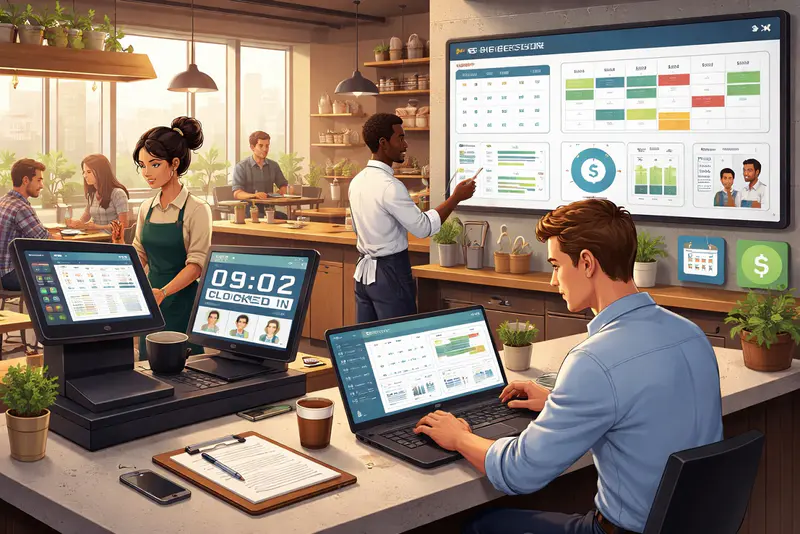
For those in the retail and service industry, a point-of-sale (POS) isn’t just another tool—it’s a system that serves as the foundation of your small business. These systems manage daily operations, track sales, and process various forms of payment to keep your business afloat.
Time management software, on the other hand, is critical for streamlining labor management, tracking hours and ensuring compliance, improving work–life balance, and fostering steady employee production.
But for those in the early stages of operating a small business, filtering through the many different aspects of POS time clock integration can be difficult. That’s where the Small Business Growth Alliance (SBGA) provides guidance, helping small business owners better understand the advantages of POS and time clock integration.
What Is POS Time Clock Integration?
The phrase itself might sound complicated, but it’s not. POS time clock integration simply refers to integrating your time-tracking software directly into your POS system.
This seamless form of automation makes it easier for staff to manage their breaks and lunch hours, clock in and clock out, and track their hours using the same technology they would for making sales. It also ensures fluidity in scheduling, managing shift changes, and automating payroll.
Smart Alerts and Simplified Scheduling
By integrating your POS and time management systems, you can set customized trackers to ensure your small business runs smoothly and complies with modern labor laws. For instance, you’ll be notified when your staff clocks in and out, making it easier to identify whether anyone is consistently clocking in early, showing up late, or stretching into overtime.
Furthermore, POS time clock integration helps you track a wide range of metrics, including minimum pay requirements, holiday or overtime pay, and other labor-related rules.
Beyond alerts and compliance monitoring, POS time clock integration also plays an important role in improving scheduling and day-to-day workforce management.
Your POS system can be designed to enable staff to indicate their future availability and time booked off, making it much easier to create automated schedules that fit their needs. This level of visibility helps business owners build schedules that are both efficient and fair.
It also simplifies the process of swapping shifts for employees. Typically, an annoying endeavor that requires workers to seek approval from managers, shift changes can instead be handled directly through the POS system, allowing managers to maintain oversight while reducing unnecessary administrative work.
Tracking Labor With Sales
Another major advantage of integrating your POS system with employee time management software is the ability to track labor costs against real-time sales data. For small business owners, labor is often one of the largest operating expenses, and overstaffing during slower periods can quickly eat into profit margins.
With POS and time clock integration, managers can view labor costs alongside hourly or daily sales performance. This makes it easier to identify trends, such as peak sales hours, seasonal fluctuations, and slower periods when fewer staff members are needed. By analyzing these patterns, small business owners can make smarter scheduling decisions that align staffing levels with actual customer demand.
Over time, this data-driven approach helps businesses maintain the right balance: enough employees to deliver excellent customer service without so many that labor costs outweigh revenue.
As digital payment ecosystems continue to evolve, modern POS systems are increasingly becoming financial hubs for small businesses. By combining payments processing, sales analytics, and workforce management into a single platform, merchants gain clearer visibility into both revenue and operating costs. This convergence allows business owners to make faster financial decisions while maintaining tighter control over margins and cash flow.
Automation Improves Payroll Accuracy
A business is nothing without accurate and timely payouts. As SBGA notes, your staff works hard and deserves to be paid promptly for it. Integrating your POS system and time management software ensures payroll accuracy across the board.
When you automate payroll into your POS system, manual calculations are no longer necessary. This can save small business owners thousands of dollars in time and effort, while also effectively eliminating the risk of human error. On top of that, it automates the often difficult process of calculating hourly pay and taxes for your workers.
While the benefits are clear, integrating your POS and time management systems can still feel overwhelming for some small business owners. For small business owners evaluating integration options, partnering with an experienced provider can help streamline implementation.
About the Small Business Growth Alliance (SBGA)
Small Business Growth Alliance (SBGA) is an organization founded by experienced small-business owners dedicated to helping entrepreneurs grow with confidence. With nearly two decades of expertise, SBGA connects businesses with trusted partners and cost-effective solutions that streamline operations, reduce risk, and support long-term success.