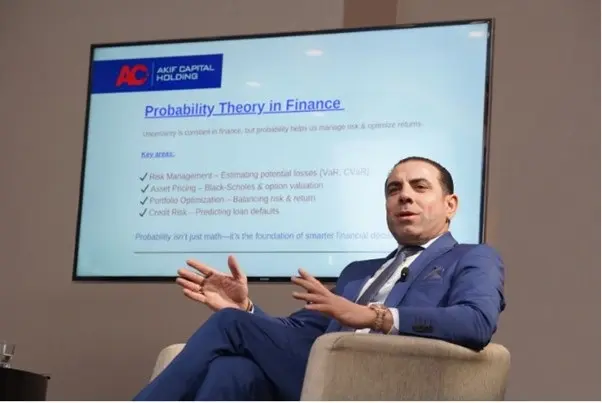
By Fedlan Kılıçaslan
Today’s markets overflow with data, yet that abundance has produced more confusion than clarity. Investors are drowned in constant updates that create a deceptive sense of control. This flood of information invites errors in judgment and encourages false confidence. Many rely on outdated models that cannot account for the sudden, nonlinear turns of modern markets.
Kılıçaslan observes that “Information without context is noise pretending to be insight.” Many financial actors mistake reaction for analysis, responding impulsively to headlines or algorithmic signals. Rational filtering and contextual understanding, he argues, now separate durable strategies from failing ones. Investors must develop the discipline to identify what matters rather than trying to process everything that crosses their screens.
Furthermore, he believes that excessive data tempts investors to replace strategic thinking with mechanical responses. By chasing instant indicators, they lose sight of the slower structural forces that create actual value. To counter this, he stresses the importance of coherence, patience, and measured interpretation grounded in long-term logic.
Turning Market Narratives into Opportunity
Excessive focus on popular opinion often traps investors in self-reinforcing cycles. He contends that the alignment of market sentiment frequently masks underlying opportunities. When public commentary turns overwhelmingly negative, many retreat even though such moments can mark potential inflection points.
Contrarian thinking, in his view, operates through reasoned analysis rather than rebellion. “Extreme narratives, whether euphoric or fearful, reveal more about collective emotion than market truth,” he explains. Recognizing distortions created by prevailing narratives requires perception and patience. Success depends on the ability to wait for conditions to align instead of rushing to follow the majority sentiment.
He emphasizes the importance of conviction when judgment collides with noise. Decisive action, guided by disciplined research, can turn moments of widespread panic into opportunities. Consistent adherence to independent evaluation allows investors to exploit an imbalance rather than fall victim to it.
Mastering Bias in a Volatile World
Human behavior remains the most unpredictable element in finance. As markets accelerate, emotional biases often determine outcomes more than information accuracy. Fear, overconfidence, and the instinct to conform intensify under uncertainty, leading to costly errors.
Kılıçaslan believes that clear perception lies at the boundary between strategic endurance and reactive collapse. He states, “Successful investors protect their objectivity like others protect capital.” Maintaining self-awareness when pressure mounts allows individuals to stay rational while others follow emotion. Consistency in thought then becomes a measurable competitive advantage.
Volatility tests whether investors can detach from emotion and recognize patterns others miss. Kılıçaslan’s experience reinforces that success stems from calm decision-making. Sound perception, maintained through reflection and discipline, prevents the cyclical mistakes that destroy capital when uncertainty rises.
Building Strategies That Adapt and Endure
His investment framework rejects inflexible thinking and prioritizes adaptability over static systems. He encourages investors to study underlying structures instead of transient signals, combining near-term awareness with long-term judgment. Clarity, context, and durability drive his philosophy.
He encourages investors to question assumptions, map global and macroeconomic factors, and build strategies that can weather disruption. This framework recognizes that constant change defines modern finance. Therefore, informed resilience replaces prediction as the true measure of success.
Kılıçaslan asserts, “Resilience is not defensive. It’s the discipline to evolve faster than the world can surprise you.” That principle defines his work: a refusal to treat volatility as a threat but rather as a proving ground. For investors who accept this challenge, turbulence becomes a source of strength.
The new mindset he promotes transforms how investors read and act on information. Instead of chasing clarity through data accumulation, they find it through refined understanding and deliberate focus. His philosophy restores human judgment to the center of capital management and reframes disruption as a condition to be mastered, not avoided.
Through this disciplined and perceptive lens, Kılıçaslan lays out a guide for sustained success in an unpredictable environment. His message remains straightforward: investors must think deeply, filter aggressively, and adapt continuously to uncover the truths obscured by noise.